Physical Address
304 North Cardinal St.
Dorchester Center, MA 02124
Physical Address
304 North Cardinal St.
Dorchester Center, MA 02124

A fifteen-degree daily swing, the Alhambra within three weeks' notice, the high Alpujarras at their finest walking month — and no skiing whatsoever.
Granada has the widest daily temperature swing of any Andalusian capital in October, and it is the thing to plan around. The airport station averages 23.2°C by day and 8.7°C at night — a gap of nearly fifteen degrees. You will want a t-shirt in the Generalife at two in the afternoon and a proper coat in the Albaicín at nine.
This is also the month Granada becomes bookable again. The Alhambra, which spends spring sold out months ahead, comes back within reach at a few weeks’ notice, and the city’s autumn season opens at the end of the month with one of Europe’s oldest jazz festivals.
Granada airport records 23.2°C by day, 8.7°C at night and 40mm of rain over 5 rain days in October — the driest October of the eight capitals bar Almería.
One correction to that night figure, because it matters if you are booking a hotel in the centre. The official station sits out at Chauchina in the vega, and the vega drains cold air off the sierra at night. The Armilla station on the city edge, 127 metres higher, records October minima 1.4°C warmer — the opposite of what altitude should do, and the signature of cold-air pooling. The city itself runs warmer still. Add roughly a degree and a half to the airport minimum and you have something closer to what a night in Granada actually feels like.
Rain behaves as it does across the region: 40mm sounds like a wet month and is not. Most of October’s rain arrives in a couple of concentrated days, and dry Octobers are common. The mountains are the exception — the Sierra Nevada can take weather the city does not see.
And the daylight. Clocks go back on Sunday 25 October, and sunset drops by an hour overnight. The Alhambra’s evening visit slots and the Mirador de San Nicolás sunset both move an hour earlier from that day.
The last week, if you can only pick one. The jazz festival opens on the 27th, the Alpujarras are at their best, the city is cool enough to walk all day, and prices are at their autumn floor.
The first half is warmer and has longer evenings, which suits a first visit built around the Alhambra and the Albaicín. Avoid 10–12 October if you can — the Fiesta Nacional falls on a Monday in 2026 and the three-day weekend fills the city.
Note that Granada city itself takes no October local holiday. Its two are 2 January and Corpus in June, so ordinary life carries on all month.
Two corrections worth making, because both appear constantly in October listings. Sierra Nevada is completely shut in October — the summer lifts stopped on 23 August and the winter season does not normally open until the end of November. There is no skiing and not even the summer gondola. And the Fiesta de San Rafael is Córdoba’s, not Granada’s; it has nothing to do with this province. The Alpujarras chestnut festivals are November too, Mecina Bombarón’s falling on the 1st.
Granada is a student city and October is when it refills. The university year starts, the tapas bars along Elvira and Navas get busy again on weeknights, and the free-tapas custom — a real one here, not a tourist story — is at its most useful when you are eating indoors because the evening has turned cold.
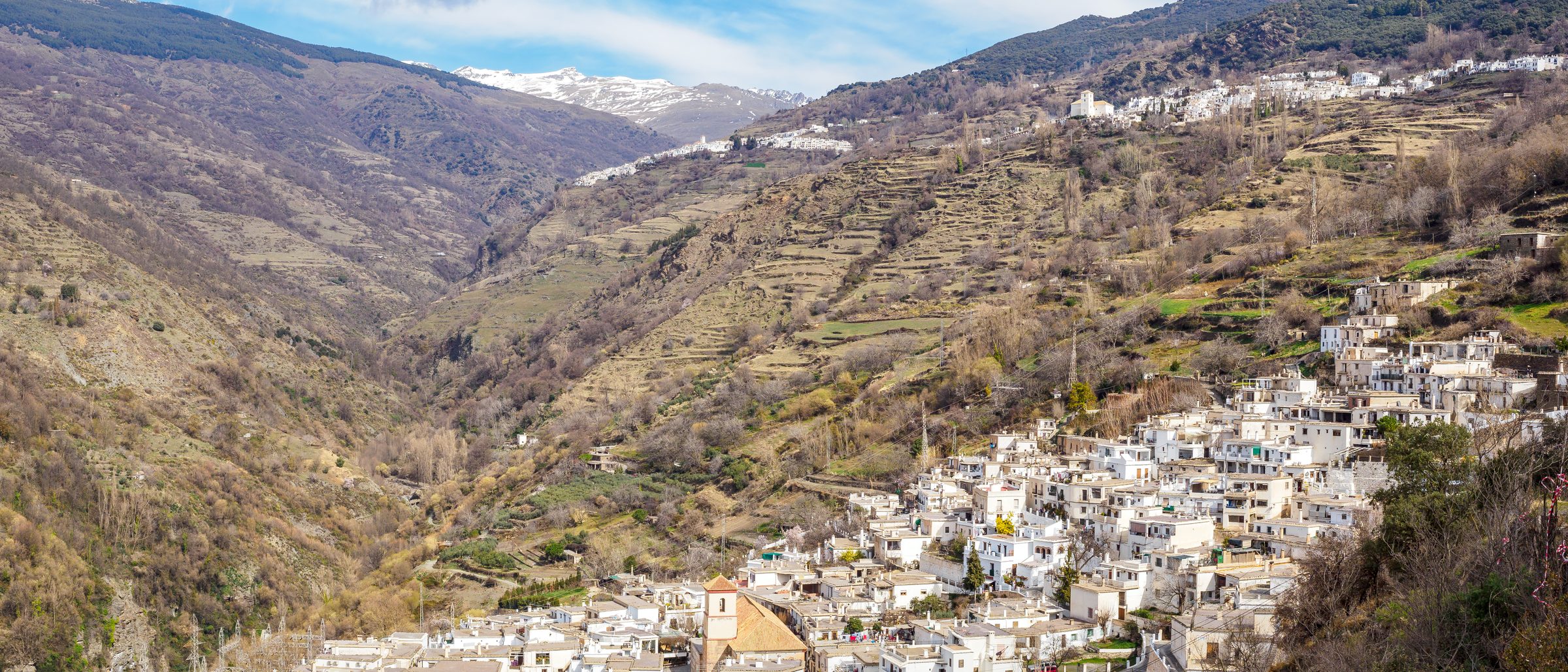
Up in the Alpujarras, October is the best walking month of the year. The heat has gone, the snow has not arrived, the chestnut woods around Pórtugos, Busquístar and Cáñar are colouring, and the high villages are doing their patronal fiestas. The passes are open, which they will not reliably be in December.
On the coast, the Costa Tropical keeps going longer than the rest of Andalucía’s beaches. There is no official buoy at Motril to quote a sea temperature from, but the water there sits between the Málaga and Cabo de Gata readings, so somewhere around 20–21°C in October — swimmable, and almost empty.
This is the practical reason to come now. In April and May the Alhambra sells out two to four months ahead and the Nasrid Palaces slots go first. In October the booking window compresses to something like three or four weeks, and you can plan a trip around getting in rather than the other way round.
The Generalife gardens are also better in October than in high summer — autumn light, the pomegranates ripe, and a temperature you can spend three hours in. Book directly and book the Nasrid Palaces time slot you actually want, because that is still the part that goes.
Walk the high Alpujarras. Trevélez, Pórtugos, Capileira, Bubión and Pampaneira are at 1,200 to 1,500 metres, which makes them an ordeal in August and impassable-feeling in midwinter. October is the window: warm enough to walk in, cold enough at night for the ham cellars Trevélez is famous for, and the chestnut woods turning as you go.
Time it with one of the village fiestas — Ugíjar on the 14th and 15th, or Trevélez on the 19th — and you get the mountains and a fiesta that has nothing to do with tourism in the same trip.
Cold at night, warm by day. Expect low twenties in the afternoon and something around 10°C after dark in the city — colder in the vega and much colder in the Alpujarras. Layers, and a real coat for the evening.
No. The resort is closed for the whole month. Summer lift operation ends in late August and the winter season typically opens at the end of November.
Three to four weeks is usually enough, against two to four months in spring. Leave it to the last few days and you may still get in, but not necessarily into the Nasrid Palaces at a civilised hour.